Skip to content
If you’ve ever walked down a city sidewalk or marveled at the height of a skyscraper, you’ve stood on the back of the world’s most popular building material. But despite being everywhere, most people often use the terms “cement” and “concrete” as if they were the same thing. In reality, they are as different as flour is from a finished loaf of bread. Understanding the specific ingredients of concrete is the first step toward a successful home project that won’t crack under pressure.
Whether you are pouring a small pad for a trash can or planning a new driveway, the chemistry behind the mix matters. Concrete is a composite material, meaning it relies on a precise recipe where each component has a specific job to do. As we dive into this guide, we will break down the science of the mix, the common pitfalls of DIY ratios, and exactly how the ingredients work together to create a stone-like surface that lasts for decades.
Concrete in Plain Terms – What It Actually Is and Why It Works

At its simplest, concrete is an artificial stone. Unlike natural stone, which is quarried from the earth, concrete is manufactured by combining a binding agent with various fillers. When these components meet, a chemical reaction occurs that transforms a liquid slurry into a solid mass.
What Is Concrete Made Of?
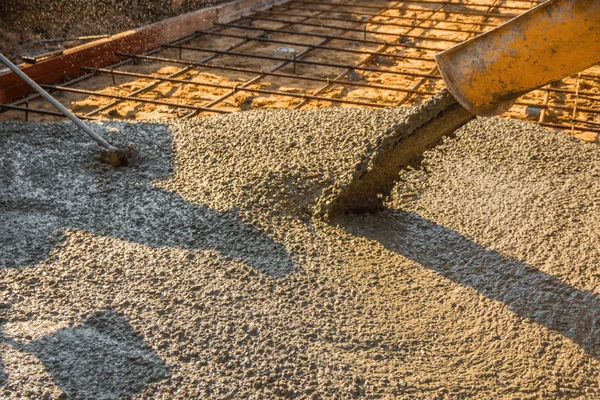
If you look at a cross-section of a dried slab, you aren’t just looking at one gray substance. You are looking at a suspension of rocks and sand held together by a hardened paste.
- The Paste: Created by the mixture of cement and water.
- The Filler: Created by fine and coarse aggregates.
- The Reaction: Known as hydration, this is the process where cement particles bond to the water, growing crystals that lock the aggregates together.
Understanding what concrete is made of is vital for any builder because if one part of the recipe is weak, if the water is dirty or the rocks are too small, the entire structure is compromised.
The Four Main Ingredients in Concrete and What Each One Does
Four pillars hold up the integrity of any mix. While there are thousands of specialty additives used in industrial skyscrapers, almost every home project relies on these ingredients of concrete.
Cement – The Binding Agent That Holds Everything Together
Cement is the glue. It usually accounts for 10% to 15% of the total volume of the mix. The most common type used today is Portland cement, a fine powder made from limestone and clay, heated in a kiln and ground to a silky consistency.
It is important to remember that cement does not dry. Instead, it cures. When cement meets water, it triggers a chemical reaction. If the cement is old or has been exposed to moisture in the bag, it won’t form the strong crystalline bonds needed to hold the heavy rocks together.
Aggregates – The Bulk That Gives Concrete Its Body
If concrete were made entirely of cement and water, it would be incredibly expensive and prone to massive cracking. That is where aggregates come in. They make up 60% to 75% of the total volume.
- Fine Aggregates (Sand): These fill the tiny voids between the larger rocks.
- Coarse Aggregates (Gravel/Stone): These provide the concrete’s structure, giving it compressive strength and durability.
The shape of the aggregate matters. Round river stones create a mix that is easy to pour, while crushed, angular stones create a mix that locks together for higher strength.
Water – The Most Misunderstood Ingredient
Water is the activator. Without it, the cement is just dust. However, water is a double-edged sword. You need enough water to make the mix workable (so you can move it with a shovel), but every extra drop of water you add beyond what is chemically required for hydration creates microscopic voids in the finished slab.
For the best results, always use potable (drinking) water. Contaminants like salt, sugar, or clay in dirty water can prevent the chemical reaction from ever completing.
Admixtures – The Optional Ingredients That Fine-Tune Performance
Think of admixtures as the spices in the recipe. Professionals use these to solve specific problems:
- Accelerators: Used in cold weather to make concrete set faster.
- Retarders: Used in summer to slow down the setting time so it doesn’t flash dry.
- Air-Entraining Agents: These create microscopic bubbles that help the concrete survive freeze-thaw cycles.
Getting the Ratios Right – Why Proportions Matter More Than Ingredients Alone

Having the right ingredients for concrete is only half the battle; the real magic happens in the proportions. Even the highest-quality cement will fail if there isn’t enough rock to support it.
The Standard Mix Ratio Explained (1:2:3)
For most general-purpose DIY projects, builders use the 1:2:3 ratio. This is a volume-based measurement that keeps things simple:
- 1 Part Cement
- 2 Parts Sand (Fine Aggregate)
- 3 Parts Gravel (Coarse Aggregate)
When these are combined with roughly 0.5 parts water, you get a mix that is strong enough for foot traffic and light vehicle loads. If you use too much sand, the mix becomes creamy but lacks strength. The mixture becomes bony and challenging to smooth out if you use too much gravel.
How the Ingredients of Concrete Change Based on the Job
Professional concrete is not a universal product. Depending on the application, the recipe changes significantly.
- Driveways: Require a higher concentration of coarse aggregates to handle vehicle weight.
- Fence Posts: Often use a dry-pour method where the ingredients absorb moisture from the surrounding soil.
- Decorative Concrete: May use smaller aggregates like pea gravel or added color pigments.
For most homeowners, the choice between bagged mix (pre-proportioned) and ready-mix (delivered by a truck) comes down to scale. The consistency of a ready-mix truck is typically worth the additional expense if you are handling more than thirty bags.
Two Common Mistakes That Start With the Wrong Ingredients or Ratios
Getting concrete right doesn’t start when you pour, it starts the moment you choose your materials and mix proportions. Even small missteps here can lead to cracking, weak surfaces, or premature failure. The tricky part is that many of these mistakes look harmless at first. The mix may seem easier to work with, or the materials might appear “close enough,” but those shortcuts often come back to haunt you months later. Understanding what not to do is just as important as following the correct process.
Adding Too Much Water – The Crack You’ll Regret Later
This is the number one mistake in residential concrete. A soupy mix is simple to pour, but it is fundamentally weak. As the excess water evaporates, the concrete shrinks. This shrinkage creates internal tension that results in unsightly cracks within the first year. Aim for a consistency like thick peanut butter, not pea soup. For example, overwatering a driveway mix might make finishing easier in the moment, but it often leads to surface scaling and spiderweb cracking after the first freeze-thaw cycle.
Using Poor-Quality or Dirty Aggregates
If you use sand from a beach or gravel from a muddy pit, you are inviting disaster. Silt and clay coat the aggregate and prevent the cement paste from bonding to the rock. Always use washed aggregates to ensure the strongest possible bond. Even small amounts of debris, like organic material, leaves, or excess dust, can weaken the mix. For instance, using unwashed sand in a patio slab can result in a brittle surface that chips or flakes under regular foot traffic.
By paying close attention to your ingredients and ratios from the start, you set the foundation, literally, for a durable, long-lasting result.
A Quick Word on Concrete vs. Cement – A Confusion Worth Clearing Up

To keep it simple: cement is an ingredient; concrete is the result. When you go to the hardware store, you buy bags of concrete mix. If you buy a bag of Portland cement, you are buying only the powder binder, which must be mixed with sand and gravel to be useful. Understanding these concepts allows you to communicate better with contractors and ensures you buy the right products for your weekend projects.
While small DIY tasks can be a fun challenge, larger structural projects require the precision that only comes with experience. If you want to ensure your next project uses the highest quality ingredients of concrete and features a flawless finish, it’s best to leave it to the experts.
Contact our professional concrete contractor today to schedule a consultation and let us handle the heavy lifting for you!
Frequently Asked Questions
1. Can I use recycled materials in a concrete mix?
Yes, using recycled concrete aggregate (RCA) is an eco-friendly way to build. Old concrete is crushed and screened for use as coarse aggregate in new mixes. While it is great for footpaths and fill, it is important to adjust your water-to-cement ratio to prevent the mix from drying out too quickly.
2. How long does concrete take to cure?
While concrete sets within 24 to 48 hours, it is considered to have reached its design strength at 28 days. During the first seven days, it is critical to keep the concrete moist (wet curing) to ensure the chemical bonds form completely.
3. What additives can improve concrete performance?
Common additives include plasticizers, which improve the flow of concrete without adding extra water, and fiber reinforcement. Adding small strands of synthetic fiber can help prevent surface cracking and increase the slab’s toughness.
4. Is there a temperature limit for pouring concrete?
The ideal temperature range for pouring is between 50°F and 90°F. If it is too cold, the chemical reaction slows down. If it is too hot, the water evaporates before the cement can use it, leading to a weak, dusty surface.
5. How can I test concrete strength at home?
Homeowners can use a slump test. Fill a cone-shaped container with wet concrete, flip it over, and measure how much the pile slumps down. A 3-to-4-inch slump is usually perfect for residential work.
6. What are the 4 main ingredients of concrete?
The four essential components are Portland cement, water, fine aggregate (sand), and coarse aggregate (gravel or stone). These four form the foundation of almost every concrete structure on the planet.