Skip to content
A driveway that cracks and spalls within a few years usually wasn’t a bad concrete job — it was the wrong concrete driveway mix for the conditions. Santa Fe sits above 7,000 feet, swings 40+ degrees between a summer afternoon and midnight, freezes hard in winter, and gets pounded by sudden monsoon downpours. A standard mix built for a mild climate isn’t built for that.
The short answer to what is the mix for concrete driveways in the local area is: 4,000 PSI minimum, air-entrained, poured over a properly compacted subgrade, with correctly spaced joints. Get those three right and a driveway lasts 30–40 years. Get any one wrong, and you’re looking at repairs within 5–10.
This guide covers the specs that matter, why professional installation is the only reliable way to hit them, and what it actually costs to do it right in Santa Fe, Eldorado, Tesuque, and the surrounding high-desert region. Now let’s look at the factors to consider when choosing a concrete mix for driveways in the local New Mexico area.
CONCRETE DRIVEWAY MIX BASICS: WHAT THE NUMBERS MEAN
Concrete is Portland cement, sand, gravel, and water — and the ratio of those four ingredients determines everything about how the slab performs.
Portland cement – the binder that reacts with water (hydration) to glue everything else together and give the slab its strength.
Sand (fine aggregate) – fills the gaps between the larger stones, creating a dense, workable, smooth-finishing mix.
Gravel/crushed stone (coarse aggregate) – the bulk structural filler that gives the slab most of its compressive strength and dimensional stability.
Water – activates the cement’s hydration reaction and controls workability, but too much weakens the cured slab and increases permeability.
| Spec | What it controls | Santa Fe driveway standard |
| PSI (compressive strength) | Load capacity, wear resistance | 4,000 PSI minimum; 4,500–5,000 PSI for RVs/commercial traffic |
| Water-to-cement ratio | Strength, permeability | 0.45 or lower — no water added at the pour |
| Coarse aggregate | Workability, density | 3/4-inch crushed stone, locally sourced |
A 2,500 PSI mix is fine for a sidewalk (or a light-duty concrete path mix) but not for a driveway carrying daily vehicle traffic. The cement mixing ratio most contractors quote as “extra water for easier finishing” is the most common shortcut that shortens a driveway’s life—every added gallon weakens the cured slab and opens more pathways for moisture to get in and freeze.
WHY AIR ENTRAINMENT ISN’T OPTIONAL HERE
Air-entrained concrete has billions of microscopic air bubbles mixed in on purpose. When water inside the slab freezes and expands (~9%), it has somewhere to go instead of cracking the surface from the inside out.
- Santa Fe can see dozens of freeze-thaw cycles per winter, which affects concrete driveway mixes
- ACI recommends 6–7% total air content for driveways at this elevation and exposure level
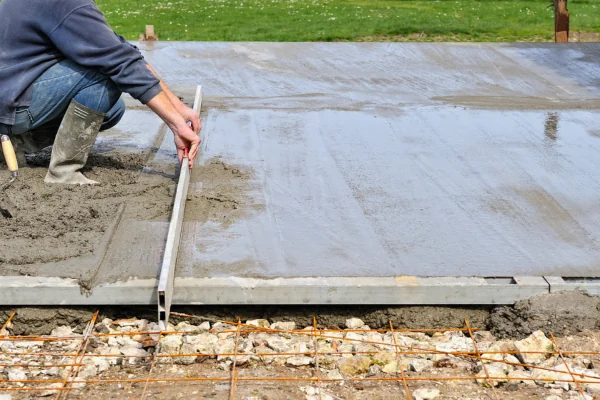
- Air-entrained mixes need a finisher who won’t overwork the surface while bleed water is present — doing so traps moisture right where freeze-thaw damage starts
This is one of the biggest reasons DIY or bargain pours fail early: the mix might be air-entrained on paper, but improper finishing cancels the benefit out. This is why professional services and installation matter so much for determining the best concrete mix for driveways.
SUBGRADE PREPARATION: THE WORK THAT HAPPENS BEFORE THE CONCRETE
The concrete mix itself is only part of the equation. A correctly specified 4,000 PSI air-entrained mix will still crack and sink if it is placed on a poorly prepared subgrade. In Santa Fe and surrounding areas like Galisteo, Pojoaque, and Seton Village, subgrade conditions vary considerably and require careful evaluation before pouring any concrete.
Dealing With Expansive Clay and Caliche Soils
Much of the Santa Fe region sits on expansive clay soils and caliche — a hardened calcium carbonate layer common throughout the Southwest. Expansive clay absorbs moisture and swells, then shrinks as it dries. That repeated movement exerts upward and lateral pressure on concrete slabs, causing cracking and displacement over time.
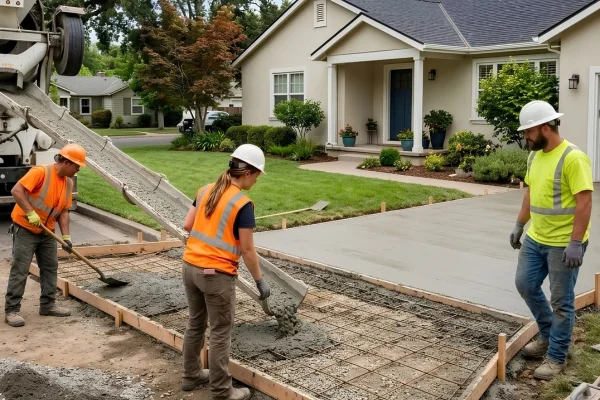
Proper subgrade preparation begins with removing organic material and soft or unstable soil to a depth that reaches competent, stable ground. In areas with heavy clay content, this may require importing and compacting a granular base material — typically 4 to 6 inches of compacted crushed aggregate — to create a stable, well-draining platform for the slab. Where caliche is present, you may need to break it up and remove it, or use it strategically as a base layer depending on its depth and consistency.
Compaction and Drainage
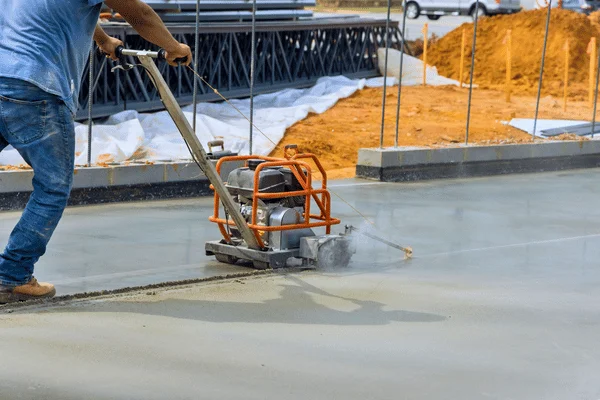
A compacted subgrade is not the same as undisturbed soil. Proper compaction uses mechanical equipment — a plate compactor or jumping jack — to achieve a minimum of 95 percent Proctor density. This eliminates voids and reduces the risk of differential settlement, where one section of the slab sinks while an adjacent section remains in place, creating a step crack or a tilted surface.
Drainage is equally important. Santa Fe’s monsoon season brings intense, short-duration rainfall that can overwhelm poorly graded surfaces. A concrete driveway should slope at least 1/8 inch per foot away from structures to direct stormwater to appropriate drainage paths. In areas with known drainage issues — common in parts of Eldorado and lower-lying neighborhoods — French drains or channel drains may be integrated into the driveway design to prevent water from pooling beneath or around the slab.
CONTROL JOINTS AND EXPANSION JOINTS: MANAGING THERMAL MOVEMENT
Santa Fe’s temperature swings mean concrete constantly expands and contracts. Without joints, that movement creates random cracking.

| Joint type | What it does | Concrete Driveway Mix Spec |
| Control joints | Directs cracking to a planned line instead of random cracks | Spaced at 2.5x slab thickness (every ~10 ft on a 4″ slab); cut ¼ of slab depth within 4–12 hrs of finishing |
| Expansion joints | Isolates the slab from garages, sidewalks, and other fixed structures | Full-depth, filled with compressible foam + sealant; required anywhere the driveway meets a fixed structure |
Skipping expansion joints at the garage apron is one of the most common — and most avoidable — causes of early cracking in this climate.
SLAB THICKNESS AND REINFORCEMENT
| Use case | Minimum thickness | Reinforcement |
| Standard residential driveway | 4 inches | Welded Wire Reinforcement (WWR) |
| Marginal subgrade / occasional heavy loads | 5 inches | Rebar preferred |
| Commercial or dedicated RV/boat parking | 6 inches | Rebar, No. 3–4 on 18″ centers |
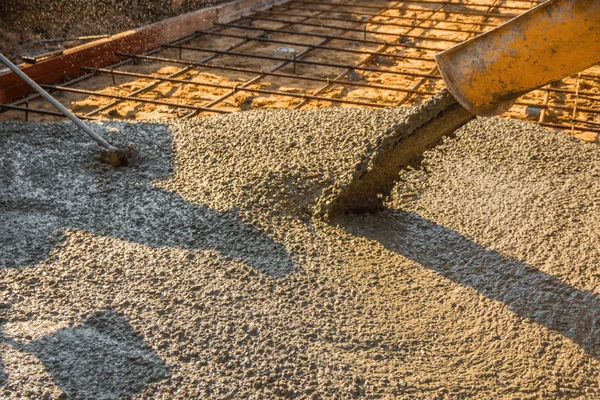
Reinforcement has to sit in the middle third of the slab—not resting on the ground during the pour, a common and costly installation error. Fiber reinforcement can help with shrinkage cracking during curing but doesn’t replace structural rebar or WWR.
THE REAL COST OF GETTING IT WRONG: ROI AND LONGEVITY
A professionally installed concrete driveway in Santa Fe, built to the correct specifications, has a realistic service life of 30 to 40 years with routine maintenance. A driveway installed with an undersized mix, inadequate base preparation, or missing joints may begin showing serious problems within 5 to 10 years — and replacement costs are not significantly less than the original installation.
Cost Benchmarks for Santa Fe Driveways
A 20×20 concrete driveway — 400 square feet — in the Santa Fe area typically costs $3,200 to $6,000 for a standard broom-finished installation, depending on site conditions, required subgrade work, and current material costs. That range reflects professional-grade specifications: 4,000 PSI air-entrained mix, proper base preparation, control and expansion joints, and correct curing procedures.
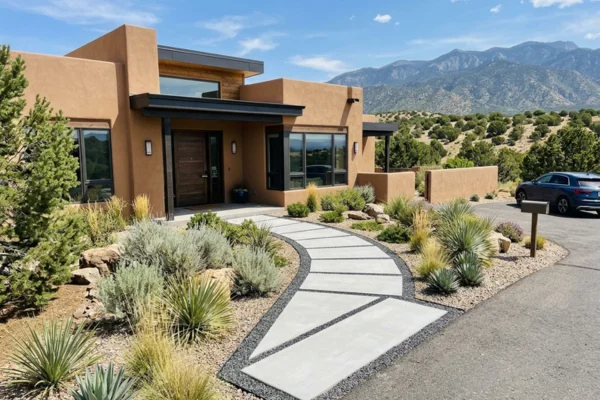
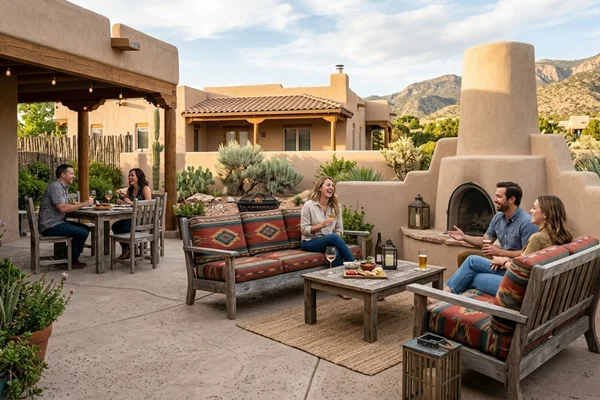
Decorative options—stamped patterns, integral color, exposed aggregate, or acid staining—add to the upfront cost but significantly increase the visual appeal and property value of the finished driveway. In Santa Fe’s real estate market, a well-executed decorative concrete driveway that complements the adobe and Pueblo-style architecture common throughout the area is a real curb-appeal asset.
What Poor Man’s Concrete Actually Costs You
“Poor man’s concrete” typically refers to a lean mix—high aggregate, low cement content—or a crushed-aggregate base compacted in place as a substitute for poured concrete. While these approaches have legitimate uses in certain applications, they are not appropriate substitutes for a structural concrete driveway. A lean mix will not achieve adequate compressive strength, will not resist freeze-thaw damage, and will deteriorate rapidly under vehicle loading. Installation savings are quickly consumed by repair costs and, eventually, full replacement.
The same logic applies to undersized mixes ordered to save money. A 2,500 PSI mix costs less per yard than a 4,000 PSI mix, but the difference in material cost across a standard residential driveway is modest — typically a few hundred dollars. The difference in service life and repair costs over 20 years is far from modest.
Get the Right Concrete Driveway Mix – The First Time, Every Time
Santa Fe Concrete Contractors builds driveways, walkways, patios, and foundations specified for New Mexico’s climate — not just for how they look on pour day. Every project gets the right PSI and air content for the elevation, proper subgrade prep, and joint placement that holds up over decades of Santa Fe winters and summers.
Planning a driveway in Santa Fe, Eldorado, Espanola, Tesuque, or White Rock? Contact us for a free on-site estimate and professional help calculating the right concrete driveway mix. — no pressure, no guesswork. You can also browse our local project gallery to see finished driveways and decorative concrete work in the Santa Fe area.

FREQUENTLY ASKED QUESTIONS
What is the best cement mix for driveways in Santa Fe, New Mexico?
A 4,000 PSI air-entrained mix with a water-to-cement ratio of 0.45 or lower, placed with 6–7% air content. A standard 2,500 PSI mix isn’t built for this elevation’s freeze-thaw cycles.
What is “poor man’s concrete,” and is it viable for driveways?
It refers to a lean, low-cement mix or a compacted aggregate base used in place of poured concrete. Both have niche, low-traffic uses but won’t hold up to regular vehicle loading or freeze-thaw cycling — the upfront savings get eaten by early repairs.
How much does a 20×20 concrete driveway cost in Santa Fe?
Typically $3,200–$6,000 for a standard broom finish, depending on site conditions and prep work. Decorative finishes add to that range. A site visit gives the most accurate number.
Is 4 inches of concrete thick enough for a driveway?
Yes, for standard passenger-vehicle use on a properly compacted subgrade. Go to 5–6 inches with reinforcement for RVs, heavier loads, or marginal soil conditions — common in parts of the Santa Fe area.
How do control and expansion joints protect a driveway in this climate?
Control joints direct cracking to planned lines instead of random cracks; expansion joints isolate the slab from garages and sidewalks so thermal movement doesn’t damage either structure. Both are essential given Santa Fe’s daily and seasonal temperature swings.